
Seamless Xtra’s Mark Dowdall recently spoke to Mohamed Zohair, Co-Founder of Cairo-based Spare Payments, a platform which enables K-12 students to spend money in a controlled, cashless environment.
Zohair, financial literacy for kids is something that parents, teachers and people in the payments industry are becoming increasingly aware of. Can you explain the concept behind Spare Payments and how you are addressing this market?
Sure, we are a digital pocket money solution provider that helps schools go cashless using either through student ID card or through wearables like wristbands. We give parents a tool to teach their kids financial literacy. So, for example, they can teach their kids how to consume safely and mindfully, and how to spend their money in a way that they can track their spending and make sure that they’re being safe with their spending.
Our platform has tools like built-in allergy blocking, so if my kid’s allergic to something, I can block it from the app. It also has limits and things like that. So overall, we’re just trying to give parents a tool to teach their kids proper financial literacy that they may not be getting at school. And we enable kids to be able to make payments in a seamless and quick manner.
Right now, you are focusing mainly on K-12 schools. What is it about this demographic that is so appealing?
Yes, you’d be surprised that there are almost no solutions for this age group. For kids who are 16 plus, or even 12 plus in some places, there is a lot more out there but when it comes to kids that are nine or ten years old, there’s absolutely nothing that they can do apart from maybe borrow their mom’s card or something and use it for payments.
One of the things that we see in the market is maybe some coupons or things that the schools give out. But these are also at risk of being lost or stolen or even taken if the kid is bullied. There’s no real digitisation happening and so we think that that’s the age group where the most value is there. When you’re a bit older and you have a debit card or credit card, it gets a bit easier. At that stage you may want to be more independent, so we see this as our sweet spot right now.
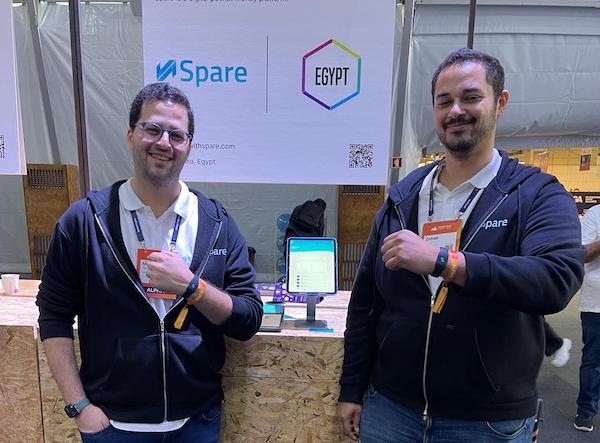
Spare Payments Co-founders Mohamed Zohair & Mohamad Tawakol
Tell me a bit more about the platform then and how you are using data to empower schools?
We started out with a very B2B model where we sell to schools and they offer it to their parents that are at the school. The Spare Payments platform is focused on parents and families and enabling them to monitor certain things things, but it also gives the schools themselves a lot of metrics which they can use to analyse how the kids are eating, have they got too many carbs in their food and other finer details like that. Even governments can monitor these kind of things too. That’s something we’re working on as well. Metrics per student on how they’re eating, how they’re consuming, because without a system in place, you can’t really track that. Being able to track it down to the individual student really helps you with the data.
It sounds like you’re actually expanding Spare Payments to offer more than simply payments and financial services?
We actually have a few expansions that we’ve already done to the system. We’re currently working with schools to automate their payments for a whole range of things from food and drink such as a monthly pre-ordering for meal plans to uniforms, trips, activities and all kinds of other things. Then we have things like attendance automation. If kids are already wearing a wristband for payments, then it makes sense to use it to check-in on campus as well. Bus scheduling is another one we are working on so there’s a lot of different pain points that we’re helping out in.
One thing to point out is that it’s actually not the hardware that our focus is on. We tell kids to bring your own hardware if you want. If you have a card, you can already use it. It’s not that for us at all. The value that we can really bring is through the front end and user experience. Because many schools are typically running on outdated software with clunky interfaces we can help automate these processes. So some kids are using wristbands. Some are totally software based. We have quite a few schools that are just using the online pre-ordering channel and that’s all. And then some are using cards. So it’s not the wearables really at all. It’s the user experience for the parents, for the kids and for the school.

Schools tend to have quite set schedules when it comes to yearly planning. How has this effected the way your business operates?
Yes, that is true. I would say, seasonality is one of the biggest challenges we have because, typically, schools prefer to systemize things one year at a time. So, they might look at their learning management stack and then maybe other services at one particular time. If you talk to a school, in March, for example, they will often say let’s wait until September and decide then. That’s not very startup friendly in terms of the numbers you’d like to have, of course, month over month, all the time. We do have a few workarounds for it that we’re working on in terms of some BTC models and things like that, but we’re still experimenting with that.
For start-ups in the Middle East, regulations can often be a key point of frustration, too. How have you fared here?
From a regulatory standpoint, it is pretty straightforward because it’s a completely closed loop You know the customers because they’re already registered at the school. So in terms of regulation, it’s akin to a booklet or a voucher or gift card because it’s only used at the one location So this really helps us not have to deal with complicated KYC, especially for kids that don’t even have a national ID or something because they’re too young. So luckily, regulation isn’t too much of a friction point there.
You started off in Cairo but what’s your presence like across the wider region today and what are your targets moving forward?
That’s right. We started off in Egypt, technically in 2018, but realistically it was 2019, early 2020 when things started moving. Covid was not a good time for us because we’re an on campus solution and at that time there was no campus. We expanded to around 30, 35 schools. And then once we started deploying our solution we actually got a couple of incoming leads from other locations. There was one school in Angola that got in touch with us, and we managed to deploy their solution remotely. We’ve been expanding a lot in the UAE as well. Right now, we have around 100 schools on the platform and a third of those are private schools in the UAE.
Really, we just want to start covering as much of what kids need cash for as possible. You’d be surprised how many payments there are when it comes to kids and school. We’re really excited to be expanding geographically, but also expanding to cover more than just school lunch payments.