

The value of e-commerce transactions will continue to rise between now and 2027, driven by improved technology, new delivery services, and wider internet adoption.
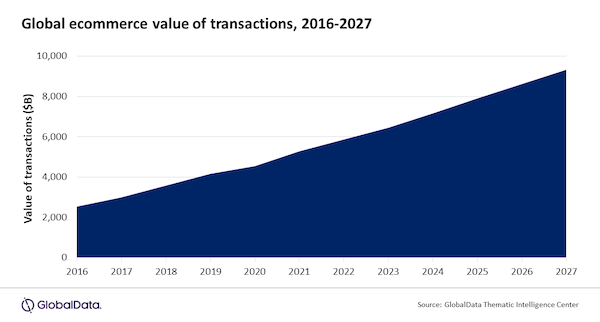
That is according to new GlobalData research which predicts the value of e-commerce transactions to hit $9.3 trillion by 2027 with a compound annual growth rate (CAGR) of 9.5%
In recent years, the global market has become increasingly democratised by e-commerce as a service companies like Shopify, and marketplaces like Amazon and Alibaba, that allow anyone to become a merchant.
GlobalData’s latest report, “Ecommerce,” reveals that global ecommerce transactions grew from $2.5 trillion in 2016 to $5.9 trillion in 2022 at a compound annual growth rate (CAGR) of 15%. COVID-19 was a crucial factor in this growth as the pandemic lockdowns accelerated the shift to online shopping.
Aisha U-K Umaru, Analyst, Thematic Intelligence at GlobalData, says: “Although the e-commerce industry will grow globally, key geographical disparities can be observed. The US and China currently dominate the market and will account for over half of the e-commerce industry’s value in 2027. However, emerging markets should not be overlooked.”
India is one of the world’s fastest-growing ecommerce markets, and GlobalData expects Indian e-commerce spending to grow at a CAGR of 23% between 2022 and 2027. This is primarily thanks to its massive population, increased internet and smartphone penetration as well as growing consumer purchasing power.
E-commerce is an extremely fragmented market. Within each sector, one or two players typically dominate, while mega-players that haven a presence across the e-commerce ecosystem challenge each other for leadership in as many niche segments as possible.
The report suggests, however, that regulatory bodies holding antitrust and data privacy concerns may prohibit the internet super-monopolies’ plans to continue their expansion.
Umaru adds: “We have seen regulators try to stop M&A deals, such as Microsoft’s acquisition of Activision Blizzard. With this rhetoric of anti-competitive regulation, it will be interesting to see new players emerge to challenge the incumbents.”
The barriers to entering the e-commerce market are being abolished by e-commerce as a service players that help anyone sell products online. Online marketplaces also enable new merchants to enter the ecommerce industry. They exist across sectors, from restaurant marketplaces to gaming marketplaces.
Umaru concludes: “Companies like Shopify and Squarespace allow merchants of all sizes to build ecommerce shopfronts at low fees and without the need for any coding experience. Marketplaces such as Amazon and Alibaba also facilitate this e-commerce democratization by allowing sellers to tap into their e-commerce infrastructure and audience. As more and more sellers go online, it will be interesting to see how the e-commerce landscape will evolve to provide for the ever-expanding range of goods on offer.”