
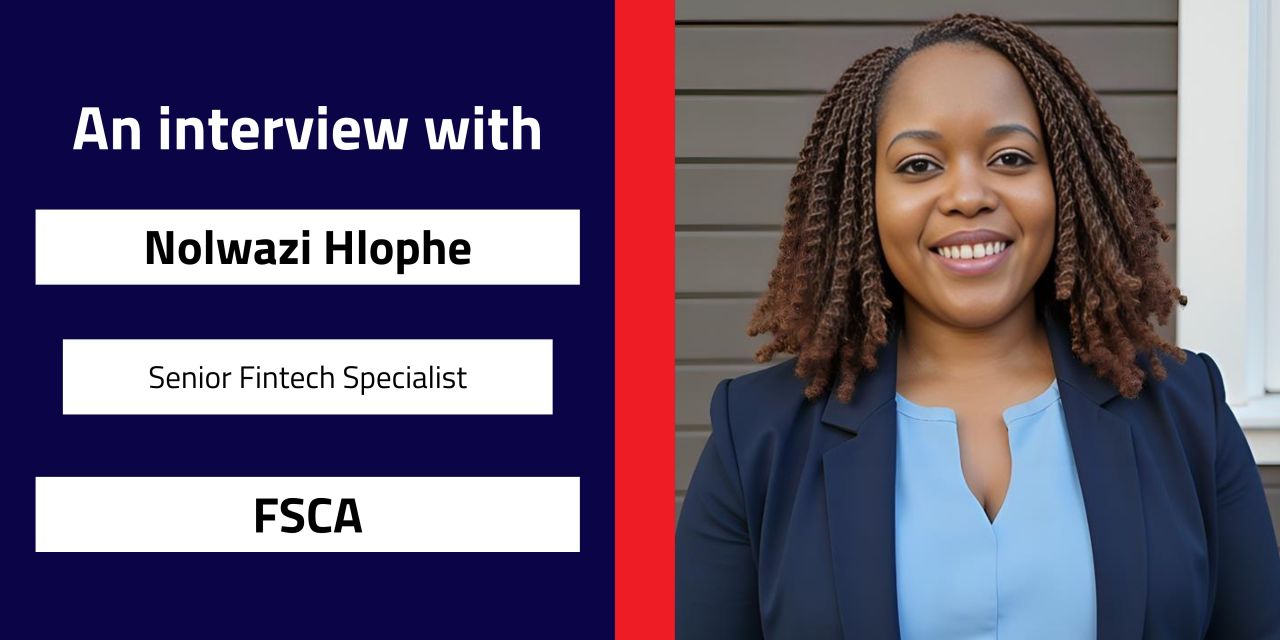
Seamless Xtra’s Alia AlHussein interviews Nolwazi Hlophe, Senior Fintech Specialist, FSCA.
Nolwazi is a Senior Fintech Specialist in the Fintech Department of the FSCA, co-leads the Regulatory Guidance Unit of the IFWG, and is Deputy Chair of the OPI WG. She holds a master’s in economics from the University of Pretoria. Her research covers AI in finance, decentralized finance, and open finance. With over a decade in financial services, she has shaped regulatory frameworks to foster innovation and consumer protection. Nolwazi is a published author and speaker, passionate about tech-driven financial inclusion and economic growth.
Shaping the Future of Fintech and AI in South Africa:
1.Regulation of Fintech in South Africa: As a Senior Specialist at FSCA, how do you approach the regulatory challenges posed by the rapid growth of fintech in South Africa, and what role do you see regulation playing in balancing innovation with security?
As a Senior Fintech Specialist, I approach the regulatory challenges posed by the rapid growth of fintech in South Africa with a focus on balancing innovation and consumer protection. I emphasize the importance of monitoring and analysing emerging products, business models, and technologies to ensure that our regulatory frameworks remain relevant and effective. My work includes leading research on artificial intelligence, open finance, and decentralized finance, which are critical areas in the evolving fintech landscape, which informs regulatory frameworks for the fintech landscape in South Africa.
Regulation plays a crucial role in balancing innovation with security in the fintech sector. Effective regulation provides a clear framework within which fintech companies can operate, reducing uncertainty and encouraging investment. It also helps to mitigate risks associated with new technologies, protecting consumers from potential harms such as fraud and data breaches. The regulatory guidance unit and the regulatory sandbox of the Intergovernmental Fintech Working Group (IFWG) are integral to my approach. These initiatives aim to adapt regulatory frameworks to keep pace with technological advancements, ensuring that the fintech sector can grow sustainably and securely. The regulatory sandbox, in particular, allows fintech companies to test innovative products and services in a controlled environment, facilitating innovation while ensuring compliance with regulatory standards. By leveraging these tools, I aim to create a supportive environment for fintech innovation that also ensures financial stability and consumer protection.
2. Fintech Ecosystem in Africa: How do you evaluate the current state of the fintech ecosystem in South Africa compared to other African countries, and what are the key areas that need development to foster growth?
The fintech ecosystem in South Africa is one of the most advanced and dynamic in Africa. With over 147 fintech startups, the sector represents a significant 30% of our country’s startup ecosystem. In 2022 alone, we attracted over $132.5 million in investment. The landscape is incredibly diverse, covering areas such as payments and remittances, lending and financing, insurtech, and investech. Companies like Yoco, iKhokha, and Adumo are leading the way with innovative payment solutions.
We also benefit from a well-established regulatory framework. Institutions like the Intergovernmental Fintech Working Group (IFWG) play a crucial role in promoting a sound and effectively regulated financial system. Fintech startups contribute significantly to our economy, providing 40% of work across all sectors and creating numerous jobs. The sector is expected to continue growing, with the African fintech market projected to reach $65 billion by 2030.
When compared to other African countries, South Africa stands out alongside Nigeria, Kenya, and Egypt. Nigeria is a major player with a strong focus on mobile payments and digital banking, while Kenya is renowned for its mobile money services, particularly M-Pesa, which has revolutionized financial inclusion. Egypt’s fintech sector is rapidly growing, with a focus on digital payments, lending, and insurtech.
Despite our progress, South Africa’s fintech ecosystem still has areas that need development. Financial inclusion remains a challenge, with an estimated 24% of South Africans unbanked. Expanding access to financial services for underserved populations is crucial. Additionally, only 10.2% of fintech companies in South Africa have female founders, highlighting the need for more female participation and leadership in the sector. Continuous adaptation of regulatory frameworks to keep pace with technological advancements is necessary, with initiatives from the IFWG being steps in the right direction. Furthermore, there is a need for more funding opportunities, especially for early-stage startups, to create a supportive environment for investors and entrepreneurs. By addressing these key areas, we can continue to lead in the African fintech landscape.
3. AI in Financial Services: With your involvement in the National AI Strategy Working Group, how do you see artificial intelligence transforming the financial services industry in South Africa, and what are the key ethical considerations in its application?
As a member of the National AI Strategy Working Group, particularly in the trust and regulation subgroup, I see artificial intelligence (AI) having a profound impact on the financial services industry in South Africa. AI has the potential to revolutionize various aspects of the industry, from enhancing customer service through chatbots and personalized financial advice to improving fraud detection and risk management with advanced data analytics. It can also streamline operations, reduce costs, and increase efficiency by automating routine tasks and processes.
However, the application of AI in financial services comes with significant ethical considerations. Ensuring data privacy and security is paramount, as financial institutions handle sensitive personal information. There is also a need to address biases in AI algorithms to prevent discrimination and ensure fair treatment of all customers. Transparency in AI decision-making processes is crucial to maintain trust and accountability. Additionally, we must consider the potential impact on employment, as automation could lead to job displacement. By focusing on these ethical considerations, we can harness the benefits of AI while promoting a fair and inclusive financial services industry in South Africa.
To address these ethical considerations, it is important for financial innovators and regulators to work together to develop and implement robust ethical guidelines and standards. This includes conducting regular audits of AI systems to identify and mitigate biases, ensuring transparency in AI operations, and establishing clear data privacy and security protocols. By taking these steps, we can harness the potential of AI in the financial services industry while safeguarding ethical standards and protecting consumers.
4. Collaboration Between Regulators and Innovators: How can regulators and fintech innovators collaborate more effectively to ensure the development of a secure, transparent, and inclusive financial ecosystem in South Africa?
Regulators and fintech innovators can collaborate more effectively by fostering open communication and building trust-based relationships. Regular dialogue and consultation sessions can help both parties understand each other’s perspectives, challenges, and objectives. Establishing joint working groups or committees can facilitate the co-creation of regulatory frameworks that are both flexible and robust, accommodating innovation while ensuring consumer protection and financial stability. In particular, we have had some industry engagements within the Crypto Assets Working Group (CAR WG) of the IFWG, where we have already engaged with FINASA, Tether and many others. Additionally, as the Fintech Department of the FSCA, we have engaged with many fintech innovators including RelyComply,
Promoting transparency in regulatory processes and decision-making can build confidence among fintech companies, encouraging compliance and cooperation. By working together, regulators and fintech innovators can create a secure, transparent, and inclusive financial ecosystem that benefits all stakeholders in South Africa.
5. Future of Fintech and AI Integration: As fintech and AI continue to converge, what do you foresee as the most significant opportunities and risks for the South African financial sector, and how should businesses and regulators prepare for these changes?
The convergence of fintech and AI presents significant opportunities and risks for the South African financial sector. On the opportunity side, AI-driven fintech solutions can enhance financial inclusion by providing personalized services to underserved populations, improving access to banking, credit, and insurance. Additionally, AI can automate routine tasks, streamline operations, and reduce costs for financial institutions, leading to more efficient service delivery and lower fees for consumers. Advanced AI algorithms can also improve fraud detection and risk management, enhancing the security and stability of the financial system. Moreover, the integration of AI can spur the development of innovative financial products, such as robo-advisors and AI-driven investment platforms.
Currently, we are conducting a market study on AI in the financial sector of South Africa, which is crucial for understanding the specific impacts and potential of these technologies in our local context. This study will provide valuable insights into how AI can be effectively integrated into our financial systems and help identify areas that require regulatory attention.
However, these advancements come with risks. The use of AI in fintech involves the collection and analysis of large amounts of personal data, raising significant data privacy and security concerns. AI algorithms can also perpetuate biases present in the data they are trained on, leading to unfair treatment of certain groups and exacerbating existing inequalities. The rapid pace of technological advancement can outstrip the ability of regulators to keep up, creating regulatory gaps and uncertainties. Additionally, automation and AI-driven processes can lead to job displacement in sectors involving routine tasks.
To prepare for these changes, businesses should invest in AI and data analytics capabilities, implement robust data privacy and security measures, ensure transparency and fairness in AI algorithms, and upskill employees to work alongside AI technologies. Regulators should develop adaptive regulatory frameworks, promote collaboration between regulators, fintech companies, and AI experts, implement regulatory sandboxes for safe experimentation, and focus on consumer protection to ensure that AI-driven financial services are fair, transparent, and secure. By addressing these opportunities and risks proactively, businesses and regulators can harness the potential of fintech and AI to create a more inclusive, efficient, and secure financial ecosystem in South Africa.