
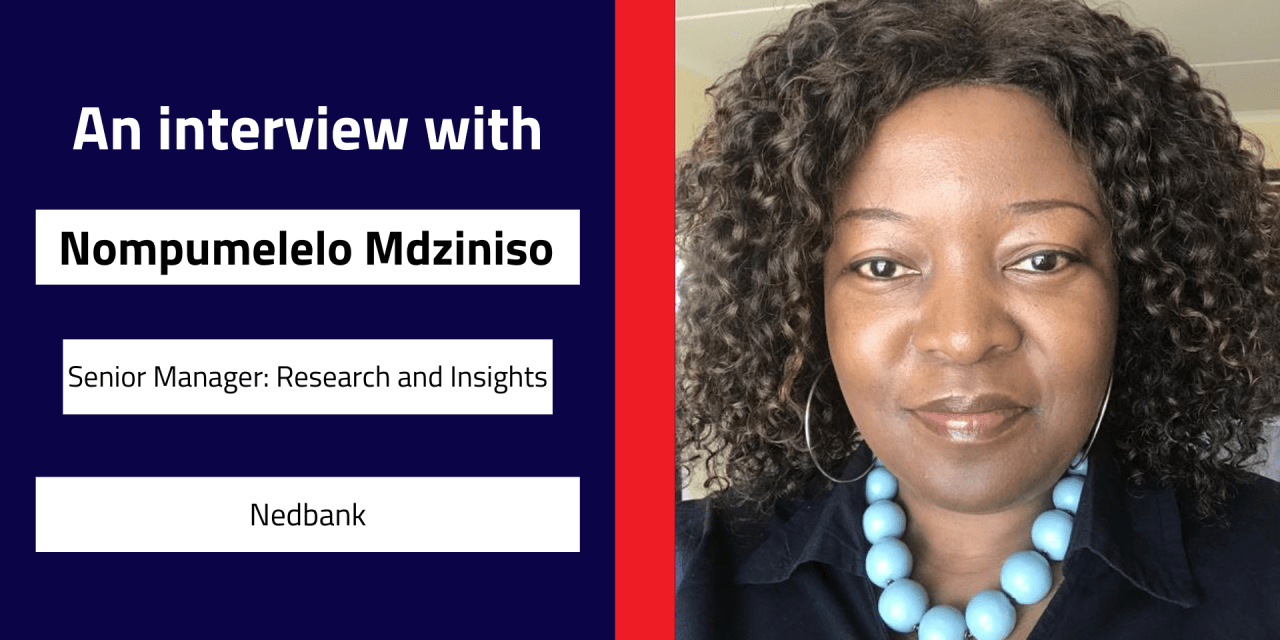
Seamless Xtra’s Alia AlHussein interviews Nompumelelo Mdziniso, Senior Manager: Research and Insights at Nedbank
With over 19 years of experience in the financial and market research sectors, Nompumelelo is an experienced Strategic Insights expert with extensive expertise in Retail and Business Banking. Her expertise encompasses Consumer and Juristic Insights, Competitor Intelligence Monitoring, Qualitative and Quantitative Market Research, Design Thinking Methodology, and Project Management.
Nompumelelo has worked with several prominent banks in South Africa, including Standard Bank, Absa, African Bank, and Nedbank. Her work involves providing strategic direction to organisations by extracting key insights through understanding juristic and consumer psychographics and pain points, constructing client personas, and creating journey maps. She has a proven track record of gathering relevant insights and effectively disseminating them across various organisational levels and audience sizes. Known as the ‘Voice of the Customer’ in every role she undertakes, Nompumelelo is driven by an innate curiosity to understand consumer behavior.
Market Research in Retail and Business Banking
1.How do you approach identifying emerging trends in the financial services industry, and what methods do you use to differentiate between short-term fads and long-term shifts?
Our purpose as a financial institution is to use our financial expertise to do good for individuals, families, businesses and society. Which links to our vision to be the most admired financial services provider in Africa by our staff, clients, shareholders, regulators and society.
One of our core values is that of being Client- Driven, which to the core of it speaks to having a detailed and in-depth knowledge of our clients, not only as banking clients but as individuals and juristic entities in society who are enabled by us to achieve their ambitions and goals.
Banking is seen as a ‘grudge purchase’, however banking is in many ways an integral part of people’s day to day living and we identify emerging trends in the financial services industry by seeking to understand the pain-points and needs that our clients have and to also understand how they are trying to solve for those pain points.
A good way of differentiating between short – term fads and long-term shifts is to identify whether that emerging trend provides a sustainable solution to the client’s pain point or need and to balance with analysing whether that shift will evolve and meet the consumer’s needs as their need changes or iterates. This is equally applicable to juristic entities who have short, medium as well as long term strategies. They need to ensure that whatever strategy they take (based on a projected trend or shift) has to be the right strategy which will enable that entity to deliver sustainable growth.
2.With digital transformation reshaping the banking landscape, how can research and insights teams better anticipate changes in consumer behaviour and financial product adoption?
Changes in consumer behaviour are caused by factors which are sometimes quite obvious and some which might be subtle and less noticeable. In a Retail Banking context, the socio – economic context is a very important factor to look at, changes in employment rates, government policies, inflation, stability of the electricity grid always have a direct impact on consumer behaviour changes. Societal factors such as changing family spending patterns, the increase of single – headed families, the drop-in marriage rates, the increase of employment rates amongst women are just a few examples of indicators of elements that can shift consumer behaviour.
In a Business and Corporate Banking context, the regulatory environment, energy sustainability energy policy, economic growth and market demand affect changes in juristic behaviour.
Research and Insights teams are best placed to understand all these factors with the ultimate aim of providing client centred financial products. We have a wide variety of tools that we use such as using predictive analytics to understand internal client data and analyse the shifts and behaviours from that perspective as well as to understand the shifts in external data which can include social media interactions, or even data from government departments and parastatals. The study of technological advancements from emerging economies are quite key because we find that they directly meet needs in society across the different income groups.
The most important part of this is the direct engagement with our clients through primary qualitative and quantitative research methodologies from whom we seek to understand their lives, ambitions and goals.
3.What are some of the biggest challenges in conducting market research in the financial services industry, particularly in a dynamic and highly regulated market like South Africa?
Some of the biggest challenges in conducting market research in the financial services in South Africa are the regulations around the protection of client data which can limit the scope and methods used for data collection. Nedbank subscribes to the highest standards of data protection, even though we are highly client centred, we implement robust security measures to protect sensitive information and further to that we also ensure that we do not share our client details with our partner research agencies without our clients’ consent. Sometimes this does restrict us in terms of sample sizes, but we are able to ensure that we operate within the legislative boundaries of data protection.
Secondly, some sub-segments of the market such as populations that might not be very tech-savvy such as Senior Citizens and Low Income or Rural sub-populations who might not have access to digital devices, can be quite challenging to access for research purposes, however we do have ways of combining traditional and innovative data collection methods to engage with them effectively.
Thirdly, consumer trust is something that is quite important. We take extra care to build and maintain it because consumers might be hesitant to share their personal views and personal information due to privacy and security concerns, we then always make sure that we make extra efforts to gather accurate, robust and comprehensive data.