
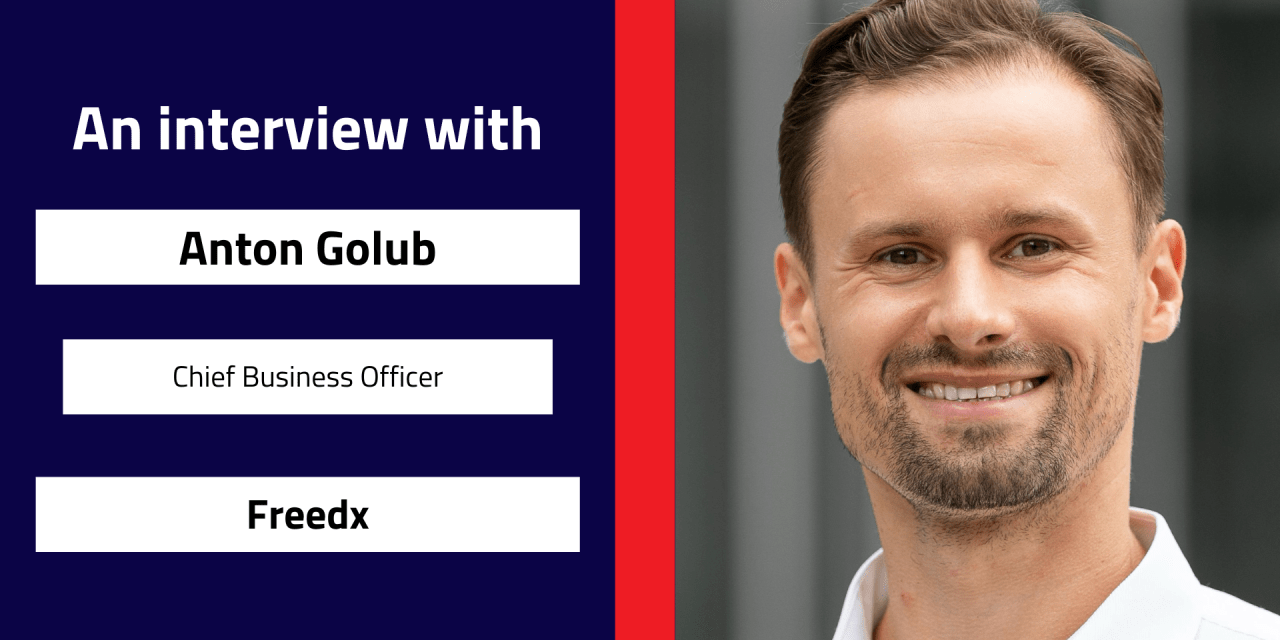
Seamless Xtra’s Paula Hallentuch interviews Anton Golub, Chief Business Officer at Freedx and Chairman of SwissAssetDAO
Anton Golub is Chief Business Officer at Freedx, a new cryptocurrency exchange based in Dubai. He is also Chairman of SwissAssetDAO, Advisor at Full Stack VC, and founder of flovtec, a Swiss digital asset market-maker. In addition, Anton co-founded Trust Square AG and Lykke Corp, a zero-fee blockchain exchange.
Previously, he was a quantitative researcher at Olsen Ltd and a Marie Curie Fellow at Alliance Manchester Business School. He contributed to the UK’s Foresight Project on algorithmic trading and several EU research initiatives. He has co-authored 13 papers and two books.
Anton spoke at Seamless Middle East 2025 in the interview session ‘Stablecoins in MENA: shaping the future of financial infrastructure’.
Stablecoins: the invisible rails powering a $1T/month crypto economy Rails Powering a $1T/Month Crypto Economy
- What exactly are stablecoins, and how are they different from regular cryptocurrencies like Bitcoin or Ethereum?
Stablecoins are digital assets designed to maintain a stable value by being pegged to a fiat currency – most commonly the US dollar. The leading issuers today, like Tether (USDT) and Circle (USDC), have issued over $260 billion in total across blockchains.
Unlike cryptocurrencies such as Bitcoin or Ethereum, which are volatile and speculative in nature, stablecoins are meant to behave like cash – offering the stability of fiat combined with the programmability and speed of blockchain infrastructure. This makes them ideal for transactions, settlements, and as an on-chain alternative to holding dollars.
- How do you see stablecoins changing the way we make payments and handle money in the future? Could they eventually replace traditional currencies?
The real innovation with stablecoins isn’t the currency – it’s the rails.
Today, over 90% of stablecoin usage is not for retail payments. It’s dominated by proprietary trading firms, hedge funds, and market makers who move funds between exchanges, provide liquidity, and arbitrage prices. These players use stablecoins to settle trades 24/7 with global reach and no bank delays.
Stablecoins are already processing over $1 trillion per month, mostly in institutional use cases. But that infrastructure is now spreading into consumer-facing products, including remittances, merchant payments, loyalty rewards, and even machine-to-machine payments (like car wallets).
They won’t replace traditional currencies, but they will bypass traditional rails. For consumers, this means money that settles instantly, works cross-border, and plugs into digital services seamlessly, without needing to go through legacy banking bottlenecks.
- Are stablecoins subject to the same regulatory oversight as traditional currencies in the UAE, and what does that mean for consumers?
UAE is positioning itself as one of the most forward-thinking jurisdictions globally when it comes to stablecoin regulation.
UAE central bank and regulators are embracing stablecoins. For example, AE Coin, an AED-backed stablecoin from MBank, is already in live circulation. Ripple’s RLUSD has been approved for use within Dubai International Financial Centre. And a third Dirham-backed stablecoin is being launched by national champions like First Abu Dhabi Bank, IHC, and ADQ.
These aren’t pilots – they’re fully licensed products embedded in real-world financial infrastructure.
For consumers, this means stablecoins issued under UAE oversight come with clear protections, institutional backing, and a path to mainstream adoption. UAE isn’t just allowing stablecoins – it’s using them to rebuild payments and finance from the ground up.
……….
Subscribe to the Seamless Xtra monthly NEWSLETTER
……….